

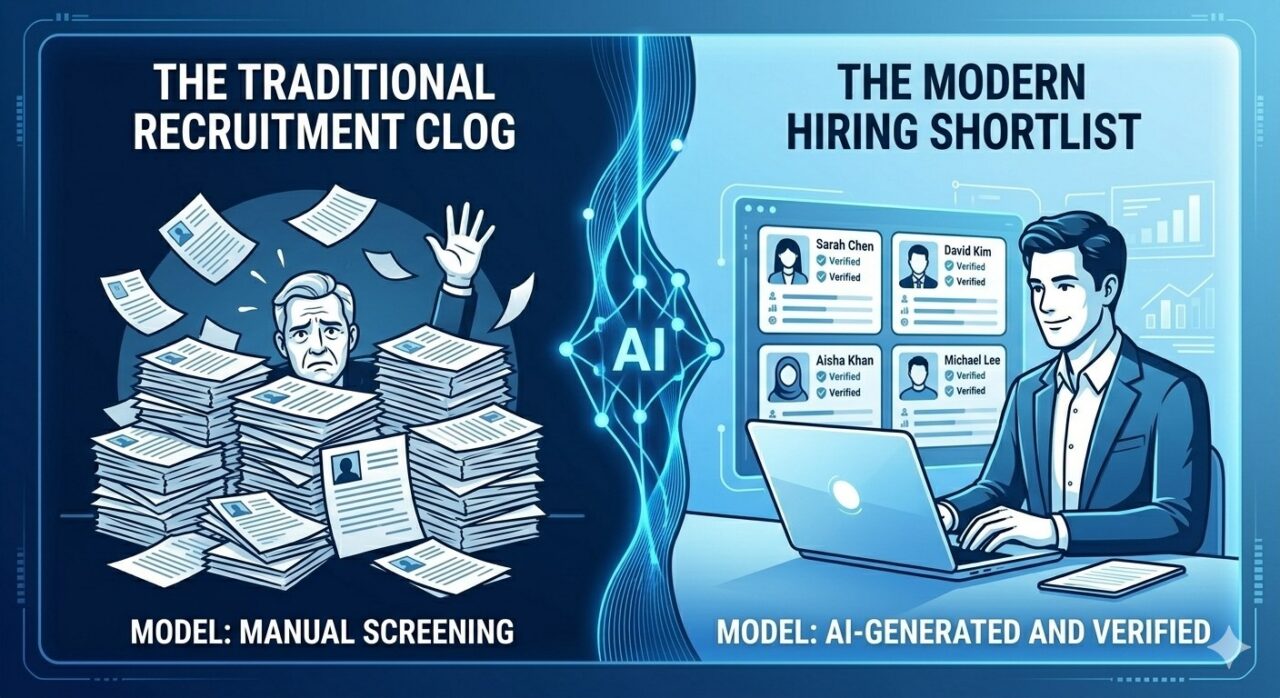
Your last developer search took eleven weeks. You reviewed 180 resumes, interviewed twelve candidates, extended two offers, and one declined. The other lasted four months before accepting a counter-offer from their previous employer.
This is the reality for most US companies trying to find software developers through traditional channels in 2026. The process is slow, expensive, and brutally inefficient — and it hasn’t fundamentally changed in twenty years.
AI has changed that. Not in the science-fiction sense — but in a very practical, measurable way. The smartest companies are now using AI-powered screening, automated skills assessments, and virtual staffing companies to compress a three-month hiring cycle into two weeks. This guide explains exactly how.
Why AI Is Reshaping How Businesses Find Software Developers in 2026
The developer hiring market has two compounding problems that AI is uniquely positioned to solve.
Problem 1: Volume Without Signal
A single senior developer job post on LinkedIn can generate 300–500 applicants within 72 hours. The vast majority are unqualified, mismatched on seniority, or applying from regions you cannot legally employ. A human recruiter screening 400 CVs introduces error, bias, and takes days. An AI screening layer processes the same volume in minutes — with consistent criteria and zero fatigue.
Problem 2: Skills Claims vs. Skills Reality
The most expensive mistake in developer hiring is not a slow hire — it’s a wrong hire. Resumes are self-reported marketing documents. A candidate who lists ‘React, Node.js, AWS’ may have used React for one project two years ago. AI-powered technical assessments — adaptive, role-specific, and evaluated programmatically — give you a verified skills signal before you spend an hour in an interview.
The Numbers Behind the Shift
| Hiring Stage | Traditional Process | AI-Assisted Process |
| Resume screening (500 applicants) | 3–5 days (manual) | < 2 hours (automated) |
| Initial skills verification | Phone screen: 2–3 weeks | Async assessment: 48–72 hrs |
| Interview shortlisting | 8–12 candidates, 2 weeks | 3–5 verified candidates, 5 days |
| Reference checking | 3–5 days, manual calls | 1 day, AI-assisted analysis |
| Total time to shortlist | 5–8 weeks | 7–10 business days |
How AI-Powered Virtual Staffing Companies Find Software Developers Faster
The companies seeing the biggest hiring speed gains are not just using AI internally — they are partnering with virtual staffing companies that have AI embedded throughout their entire sourcing and vetting pipeline. Here is what that looks like in practice.
Layer 1: AI-Driven Candidate Sourcing
The best virtual staffing companies no longer post jobs and wait. They use AI tools to proactively map talent pools — scraping GitHub contribution histories, Stack Overflow activity, LinkedIn profiles, and open-source repositories to identify developers who match a specific technical fingerprint.
This is a fundamentally different approach from keyword matching on a resume. When you search for a ‘senior Node.js developer with AWS experience,’ traditional databases return everyone who typed those words. AI-driven sourcing returns developers who have demonstrably built production systems with those technologies.
Layer 2: Automated Technical Screening
Once candidates are sourced, AI handles the first technical gate. Modern assessment platforms — HackerRank, Codility, and custom-built tools used by specialist staffing partners — deliver role-specific coding challenges that adapt in real-time to candidate responses.
The output is not just a score. It is a verified technical profile: which languages the developer is fluent in, how they approach debugging, how they structure code under time constraints, and where their knowledge has gaps. This replaces the first two rounds of human technical screening for most roles.
Layer 3: Communication and Culture Fit Screening
Technical skill is half the picture for remote hires. The other half — communication clarity, async responsiveness, documentation habits — is harder to screen at scale. AI video interview tools now analyze not just what candidates say, but how they structure explanations, how clearly they communicate complex concepts, and how they respond to ambiguous questions.
This is not about filtering for personality. It is about identifying candidates who can function effectively in a distributed, async-first environment — which is a legitimate and measurable skill set.
Layer 4: Predictive Fit Scoring
The most advanced virtual staffing companies now use machine learning models trained on placement outcome data — which candidates stayed, which ones delivered, which ones left within 90 days — to generate a predictive fit score for each candidate relative to a specific role and company profile.
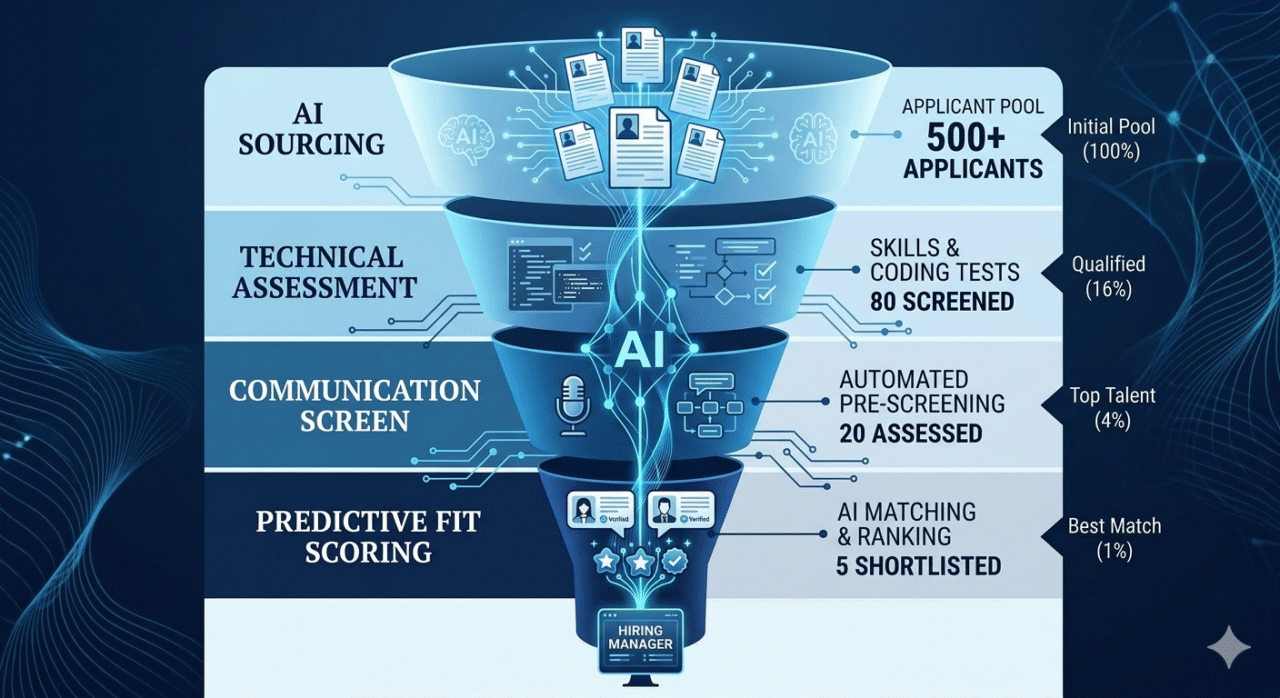
This is not magic. It is pattern recognition at scale. And for companies that have placed thousands of developers across hundreds of US clients, the training data is good enough to meaningfully improve placement quality and reduce early attrition.
Common Mistakes Companies Make When Using AI to Find Developers
AI in hiring is not a set-it-and-forget-it solution. These are the mistakes we see most often:
• Treating AI screening as the final decision. AI narrows the field — it does not make the hire. The final shortlist still needs a human technical interviewer who can probe for architecture judgment, team dynamics, and problem-solving depth. Companies that skip this step make expensive mistakes.
• Using generic AI tools for specialist roles. A general-purpose AI screener optimized for broad software roles will miss nuance for niche positions — ML engineers, blockchain developers, embedded systems specialists. The screening criteria need to be role-specific, not template-driven.
• Over-indexing on assessment scores. A developer who scores 92% on a coding challenge but cannot explain their reasoning in plain English is a remote working risk. Assessment data should inform the interview, not replace it.
• Choosing virtual staffing companies on price alone. The value of an AI-powered staffing partner is the quality of the underlying talent database, the depth of the screening pipeline, and the predictive accuracy of their matching model. A cheap partner with a shallow database delivers fast, mediocre shortlists. Fast is not useful if the candidates are wrong.
• No feedback loop with the staffing partner. AI models improve with data. If you are not sharing outcome data — which hires worked, which did not, what gaps appeared — your staffing partner cannot improve their match quality for your next hire.
Best Practices for Using AI to Find Software Developers at Speed
Here is what works when you combine AI hiring tools with a structured process:
1. Write a technical brief, not just a job description. Give your AI-powered staffing partner a 1-page technical brief: stack, seniority, type of system being built, team interface, and the three most important technical competencies. The more specific the input, the better the AI match output.
2. Use async assessments before any human interview. Send a role-specific code challenge before scheduling a single call. This alone eliminates 60–70% of mismatched candidates and saves your technical team dozens of hours per hire.
3. Combine AI scoring with a live pair programming session. The ideal technical vetting process: AI assessment for initial verification, then a 45-minute live pair programming session for depth. You see how they code, how they communicate, and how they handle real-time problem-solving.
4. Partner with virtual staffing companies that own their talent pool. The fastest placements come from staffing partners who have pre-screened candidates in an active database — not firms that post a job on your behalf and wait for applicants. Ask explicitly: do you have pre-vetted candidates available for this role today?
5. Build a feedback loop into every engagement. After 30 and 90 days, share structured feedback with your staffing partner: what worked, what did not, what the gaps were. This data improves future match quality and signals to the partner that you are a serious long-term client.
AI Hiring Tools Worth Knowing in 2026
You do not need to use all of these. The right stack depends on whether you are hiring direct or through a staffing partner. But knowing what exists helps you ask better questions.
Tool Category Best Use Case
| Tool | Category | Best Use Case |
| HackerRank / Codility | Technical assessment | Role-specific coding challenges with automated scoring |
| Greenhouse + AI Add-ons | ATS with AI screening | Resume parsing, ranking, and interview scheduling at scale |
| Interviewing.io | Live technical interview | Real-world coding interviews with anonymized candidates |
| Paradox (Olivia) | AI recruiter bot | Async screening conversations that qualify candidates 24/7 |
| Metaview | AI interview notes | Auto-summarizes interviews, extracts key signals, flags gaps |
| LinkedIn Recruiter + AI | Sourcing + outreach | Predictive candidate ranking and personalized outreach sequences |
| QlickSource Platform | End-to-end AI staffing | Pre-vetted offshore developers matched via AI to your tech brief |
Why QlickSource Is Built for the AI Hiring Era
Most virtual staffing companies use AI as a marketing talking point. QlickSource uses it as an operational backbone — embedded throughout our sourcing, screening, and matching workflow.
Here is what that looks like for a US client:
• You submit a technical brief. Our AI matches it against a pre-screened talent pool of 2,000+ verified developers — not a job board, a curated database.
• Every candidate has already passed: a technical assessment, an async communication screen, a live interview with our technical team, and a background and reference verification.
• You receive 3–5 matched profiles in 5–7 business days — with a match score, technical summary, and communication assessment for each.
• You interview the shortlist. Most clients extend an offer after 2–3 interviews. Average time from brief to signed offer: 12–14 business days.
• Post-placement, we run 30/60/90 day check-ins and remain accountable if performance issues arise — not just during the search.
Our developers are also trained in AI-augmented development workflows — GitHub Copilot, Cursor, LLM API integration — so they fit into modern engineering teams from day one, not after a three-month learning curve.
Stop searching. Start building. Submit your technical brief to QlickSource and get a shortlist of AI-matched, pre-vetted developers in 5–7 business days. → www.qlicksource.com/contact
Final Thoughts
AI has not replaced human judgment in developer hiring — it has removed the parts that were wasting your time. Screening 400 resumes manually, running phone screens that could have been a 30-minute assessment, waiting three weeks to get a technical opinion — those are process inefficiencies, not strategic activities.
The companies finding software developers fastest in 2026 are the ones who have offloaded those inefficiencies to AI — either through their own tooling or by partnering with virtual staffing companies that have already built the infrastructure.
Your product roadmap does not wait for a twelve-week hiring cycle. Neither should you.
Frequently Asked Questions
How is AI changing the way companies find software developers?
AI has transformed developer hiring at three key stages: sourcing (proactively identifying candidates based on verified skills signals rather than keyword-matched resumes), screening (automated technical assessments that verify claimed skills before any human interview time is spent), and matching (predictive fit scoring that uses placement outcome data to rank candidates by likelihood of success in a specific role). The net result is a 60–70% reduction in time-to-shortlist for companies using AI-native hiring tools or virtual staffing companies with AI pipelines.
What are virtual staffing companies and how do they differ from traditional recruiters?
Virtual staffing companies specialize in placing remote and offshore talent and typically operate with technology-first workflows — AI-driven sourcing, digital assessments, video interviews, and remote onboarding support. Traditional recruiters are often relationship-driven, geography-dependent, and rely heavily on manual processes. Virtual staffing companies can place candidates 3–5x faster because they maintain pre-screened, active talent pools rather than starting a new search from scratch for each role.
Can AI really assess a developer’s technical skills accurately?
For core technical skills — coding proficiency, algorithm knowledge, framework familiarity — AI-powered assessments are highly accurate and significantly more consistent than human technical screens, which vary widely by interviewer. Where AI still falls short is in evaluating system design judgment, architectural decision-making, and senior leadership qualities. Best practice is to use AI screening for first-pass verification and reserve human technical interviews for depth evaluation.
How do I find software developers using an offshore staffing partner?
The process is straightforward: submit a technical brief to a specialist partner (stack, seniority, type of work, timezone requirements, budget range). A quality partner like QlickSource returns a pre-vetted shortlist in 5–7 business days. You conduct 2–3 interviews from that shortlist, select your hire, and the partner manages onboarding support, compliance, and ongoing performance accountability. Total time from brief to active developer: typically 12–14 business days.
What is the risk of using AI to hire developers without human oversight?
The main risks are: over-relying on assessment scores without contextual interview depth, missing nuance for specialist or senior roles where generic screening tools are not calibrated, and creating a dehumanized candidate experience that causes strong developers to drop out of the process. AI should accelerate and sharpen human judgment — not replace it. The best hiring outcomes come from AI-assisted workflows where human decision-makers remain in the loop on final selection.
Which virtual staffing companies use AI for developer placement?
A growing number of offshore staffing firms are incorporating AI tools — but depth varies significantly. Look for partners who use AI for sourcing (not just job board posting), automated technical assessments (not just CV screening), and predictive matching against your role profile. QlickSource operates an AI-matched talent pipeline with pre-vetted developers, role-specific assessments, and match scoring for each client brief. Ask any prospective partner specifically how their AI is used and what their placement outcome data shows.
How much faster is AI-assisted hiring compared to traditional methods?
For most mid-to-senior developer roles, AI-assisted hiring through a specialist virtual staffing company reduces time-to-shortlist from 5–8 weeks to 7–10 business days — a 3–5x improvement. Total time from job brief to signed offer typically drops from 10–16 weeks (traditional US hire) to 12–18 business days (AI-assisted offshore placement). The quality of the shortlist also improves because AI screening filters on verified skills rather than self-reported claims.