


You raised a seed round. You have product-market fit signals. Your investors want to see velocity. And your CTO just told you it will take six months to hire the three engineers you need to ship the next major release.
This is the exact moment most startups start looking at offshore staffing services — and the exact moment they make the most avoidable mistakes.
Offshore outsourcing companies have a mixed reputation in startup circles, largely because early experiences were shaped by the wrong partners, the wrong models, and unrealistic expectations. That landscape has changed significantly. In 2026, the best offshore staffing services are not a compromise — they are a deliberate competitive advantage for startups that use them correctly.
This guide gives you the honest, practical framework for making offshore work for your stage.
Why Offshore Staffing Services Are a Startup Advantage in 2026
The fundamentals have not changed: offshore talent is significantly cheaper than US talent. What has changed is the quality ceiling — and that changes everything.
The Runway Math Is Stark
At $165,000 average total cost per US mid-level engineer (salary + benefits + equity dilution), a startup with $1.5M in seed funding can afford roughly 3 engineers for 24 months — with nothing left for infrastructure, marketing, or operations.
With offshore staffing services, that same $1.5M buys 5–6 senior-equivalent engineers for 24 months, plus a meaningful budget for the rest of the business. That is not a marginal difference. That is a fundamentally different growth trajectory.
The Quality Gap Has Closed
The objection that offshore developers ‘are not as good’ was partially true a decade ago and largely false today. The Indian engineering talent pool — where QlickSource specializes — now includes tens of thousands of developers who have built production systems for US product companies, worked in agile teams with US PMs, and are fluent in the modern stack.
The differentiator is not geography anymore. It is vetting. A well-vetted offshore engineer outperforms a poorly-vetted local hire every time.
Speed Is the Real Startup Currency
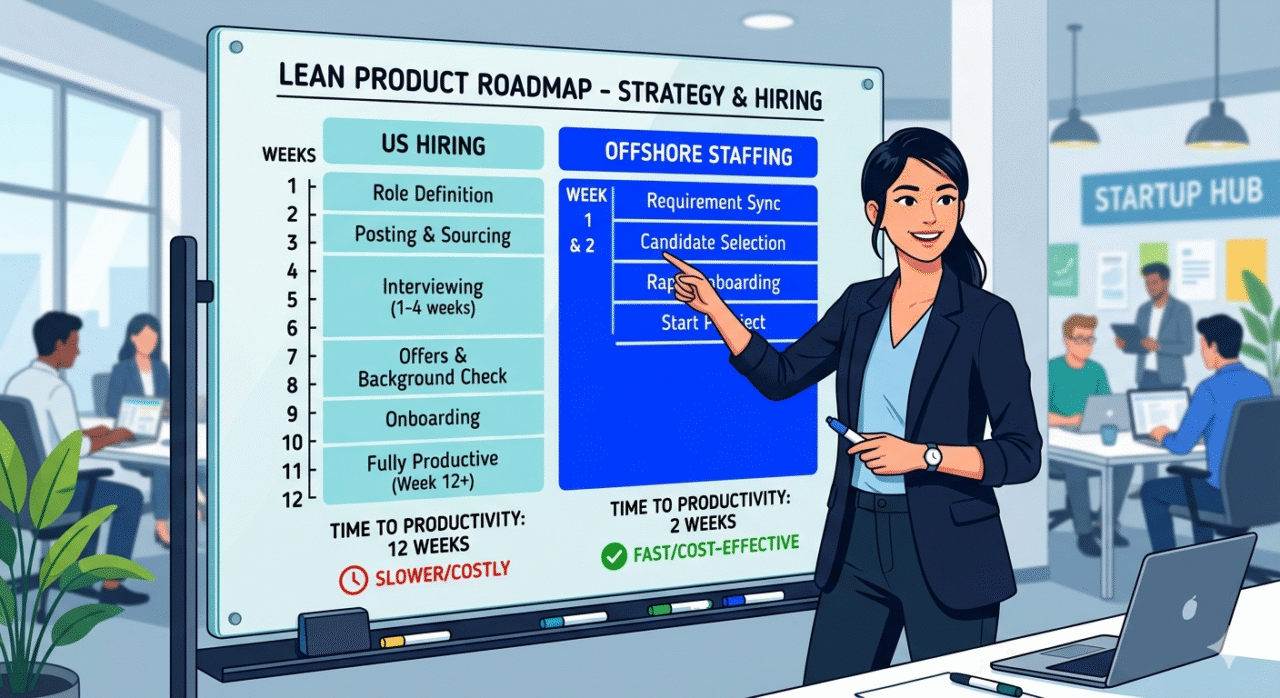
A US hiring cycle runs 8–14 weeks. An offshore staffing engagement through a quality partner runs 7–14 days. For a startup operating in three-month product cycles, that difference is the difference between shipping two releases and shipping five.
| Scenario | US Engineers Only | Hybrid (US Lead + Offshore Team) |
| Seed budget ($1.5M) | 3 engineers / 24 months | 1 US lead + 4–5 offshore / 24 months |
| Team size after 12 months | 3 developers | 5–6 developers |
| Features shipped (estimate) | Baseline | 1.8–2.2x baseline |
| Time to first hire | 8–14 weeks | 1–2 weeks (offshore) |
| Burn rate / month | $55,000–$65,000 | $30,000–$40,000 |
How to Use Offshore Staffing Services at Each Startup Stage
The right offshore model depends heavily on where you are in your journey. Using a dedicated offshore team model at pre-seed is as wrong as using ad-hoc freelancers at Series A. Here is how to calibrate.
Pre-Seed to Seed: Staff Augmentation for Speed
At this stage, you need output velocity with minimal management overhead. Staff augmentation — adding 1–3 offshore developers directly into your team under your technical leadership — is the right model.
What works at this stage:
- A single senior full-stack developer who can cover frontend, backend, and basic DevOps
- Clear sprint-based deliverables with weekly demos
- Direct reporting to your technical co-founder or CTO
- Month-to-month engagement to maintain flexibility
Series A: Dedicated Team for Scale
With product-market fit confirmed and a growth mandate, you need a structured offshore team — not just individual contributors. At this stage, a dedicated offshore team model (4–8 developers with a team lead, QA, and shared PM) gives you delivery capacity without the overhead of building a full US engineering org.
What this unlocks:
- Parallel workstreams — frontend, backend, mobile, and QA running simultaneously
- Faster feature velocity without scaling your US headcount linearly
- A stable team that builds institutional knowledge of your codebase over time
How to Choose Between Offshore Outsourcing Companies
Not all offshore outsourcing companies are built the same. The market ranges from commodity freelance platforms to specialist staffing firms with deep technical vetting infrastructure. Here is the evaluation framework:
| Criteria | Red Flags | Green Flags |
| Talent vetting | CV screening only, no technical test | Structured assessment + live interview + reference check |
| Talent pool | Aggregates freelancers on demand | Pre-screened active database of vetted developers |
| Time to shortlist | ‘We’ll post your role and see’ | Shortlist in 5–7 business days |
| Post-placement support | Placement only, no follow-through | 30/60/90 day check-ins + performance accountability |
| Pricing model | Opaque, project-based only | Transparent monthly rate, flexible engagement terms |
| Specialization | Generalist staffing agency | Tech-focused, startup-experienced, stack-specific |
Mistakes Startups Make with Offshore Outsourcing Companies
These are not hypothetical. These are patterns we see repeatedly from early-stage companies burning runway on bad offshore decisions.
- Going project-based too early. Fixed-scope offshore projects (‘build us an MVP for $15,000’) sound appealing but almost always end with scope disputes, poor quality, or abandoned handoffs. Startups need developers embedded in their team and roadmap — not a one-and-done project shop.
- No technical oversight on the US side. Offshore developers without a technical lead to review their work will drift in code quality and architecture decisions. You do not need a full-time CTO — but you need someone who can review PRs, set standards, and make architecture decisions. Without this, technical debt accumulates silently.
- Hiring the cheapest option. A $15/hour developer who requires constant re-work, produces buggy code, and cannot communicate asynchronously costs more in the long run than a $35/hour developer who ships clean, documented, tested code. Price per hour is the wrong metric — value per sprint is the right one.
- Treating offshore as a temporary fix. The startups that get the worst results from offshore staffing are the ones who view it as a short-term patch while they ‘eventually hire locally.’ The startups that get the best results treat offshore as a permanent structural advantage — and invest in onboarding, culture integration, and team stability accordingly.
- Skipping the trial engagement. Signing a six-month contract with a developer you have never worked with is unnecessary risk. Any reputable offshore staffing service will support a 2–4 week paid trial sprint. Use it. It reveals communication style, code quality, and proactivity far faster than any interview.
Best Practices for Getting Maximum Value from Offshore Staffing Services
- Start with one senior developer, not a team. The most common early-stage mistake is over-hiring offshore from day one. Start with a single strong senior developer, establish the working relationship, set the code standards, and prove the model internally before scaling to a full team.
- Build a micro-onboarding doc before they start. Two pages: product context, tech stack, coding standards, sprint structure, communication norms, and escalation path. This document eliminates 80% of the first-week confusion and dramatically shortens time to productivity.
- Run a real sprint in week one. Assign a real deliverable — not a ‘get comfortable’ exploration task. A bounded, achievable sprint task with a demo at the end gives you an immediate quality signal and sets performance expectations from day one.
- Invest in overlap hours. For India-based offshore developers, a 4-hour daily overlap with US EST covers most of the working day in IST evenings. Schedule daily standups and design reviews in this window. Async delivery happens outside it.
- Review code, not activity. Weekly PR reviews by your technical lead are non-negotiable. Hours logged or messages sent are not quality signals. Code review velocity, test coverage, and milestone delivery are.
Why QlickSource Is the Offshore Staffing Partner Built for Startups
Most offshore outsourcing companies are built for enterprise clients with large contracts, long timelines, and procurement teams. QlickSource is designed for the reality of startup hiring: lean budgets, fast decisions, and zero tolerance for bad hires.
- No long-term lock-in to start: We support trial engagements and flexible month-to-month arrangements for early-stage startups that need to validate before committing.
- Pre-vetted, startup-experienced talent: Every developer in our network has been screened for technical depth, English communication, remote working habits, and — critically — experience shipping product in agile, fast-moving environments. We do not place developers who have only worked in enterprise or waterfall environments.
- 7–14 day placement: Most startups receive a shortlist within 5–7 business days. This is not a coincidence — it is the result of maintaining an active pre-screened talent pool, not reacting to each role request from scratch.
- AI-augmented developers: Our talent is proficient in AI-assisted development workflows — Copilot, Cursor, LLM integrations — which means they ship faster than developers who are still coding entirely manually.
- Startup-friendly pricing: Transparent monthly rates, no hidden placement fees, and a model that scales with your team size — from one developer to a full dedicated team as you grow through funding rounds.
Burn rate too high? Hiring timeline too long? Book a free 30-minute call with QlickSource and get a matched shortlist of pre-vetted developers for your stack — no commitment, no long contracts to start. → www.qlicksource.com/contact
Final Thoughts
Offshore staffing services are not a last resort for startups that cannot afford US engineers. They are a deliberate leverage play for founders who understand that capital efficiency and velocity are the two variables that determine whether you make it to the next round.
The startups that use offshore staffing best are the ones who stop treating it as a workaround and start treating it as a strategy. They invest in onboarding, they set clear standards, they choose the right partner, and they build teams that are genuinely high-performing — regardless of geography.
Your competitors who are doing this well are not sharing the playbook. Now you have it.
Frequently Asked Questions
What are offshore staffing services and how do they work for startups?
Offshore staffing services place pre-vetted remote developers and technical professionals from lower-cost markets — primarily India, Eastern Europe, and Latin America — directly into your team. For startups, this typically works through a staffing partner who handles sourcing, vetting, and compliance, while the developers work under your direct management as embedded team members. You get the output of an in-house hire at 40–65% lower cost, with placement timelines of 1–2 weeks instead of 2–3 months.
Are offshore outsourcing companies reliable for early-stage startups?
Yes — with the right partner and model. The unreliable experiences with offshore outsourcing companies typically come from three sources: using project-based models instead of staff augmentation, choosing partners based on price rather than vetting quality, and not providing adequate technical oversight on the startup side. A specialist staffing partner with pre-screened talent, transparent pricing, and post-placement support is reliable for startups at any stage.
How much can a startup save using offshore staffing services?
A mid-level US software developer costs $150,000–$180,000 annually in total employment cost. An equivalent offshore developer through a quality staffing service like QlickSource costs $30,000–$48,000 annually all-in — a saving of 65–75%. On a $1.5M seed round, the difference between an all-US and offshore-augmented team can mean the difference between 18 months of runway and 30 months.
What types of roles are best suited for offshore staffing at a startup?
Full-stack development, backend engineering, mobile development (iOS and Android), QA automation, DevOps and cloud infrastructure, and frontend engineering are all strong fits for offshore staffing. Core product architecture decisions, direct enterprise sales support, and roles requiring daily co-location with US clients are better kept in-house or in a hybrid model with a local lead.
How do I manage an offshore developer when I have no technical background?
If you are a non-technical founder, the key is to have at least a part-time technical advisor or fractional CTO on your side who can review code, set architecture standards, and evaluate quality. The offshore developer manages their own execution — you manage outcomes and milestones. Use project management tools (Linear or Jira), async updates (Loom), and a weekly demo cadence to stay informed without needing to read code yourself.
What is the difference between offshore staffing and offshore outsourcing?
Offshore staffing means placing individual developers directly into your team — they work under your management, follow your processes, and are accountable to your leads. Offshore outsourcing typically means contracting an external team or agency to deliver a project outcome — they manage themselves and you receive a deliverable. For startups, staffing is almost always better than outsourcing because it gives you control over quality, architecture, and team culture.
How quickly can QlickSource place an offshore developer for my startup?
Most startup clients receive a shortlist of 3–5 pre-vetted, matched candidates within 5–7 business days of submitting a technical brief. Interviews are typically completed within 10–12 business days, and the developer can begin onboarding within 2–3 weeks of first contact. For urgent requirements, we can often compress this further by drawing from active candidates already in interview-ready status.