


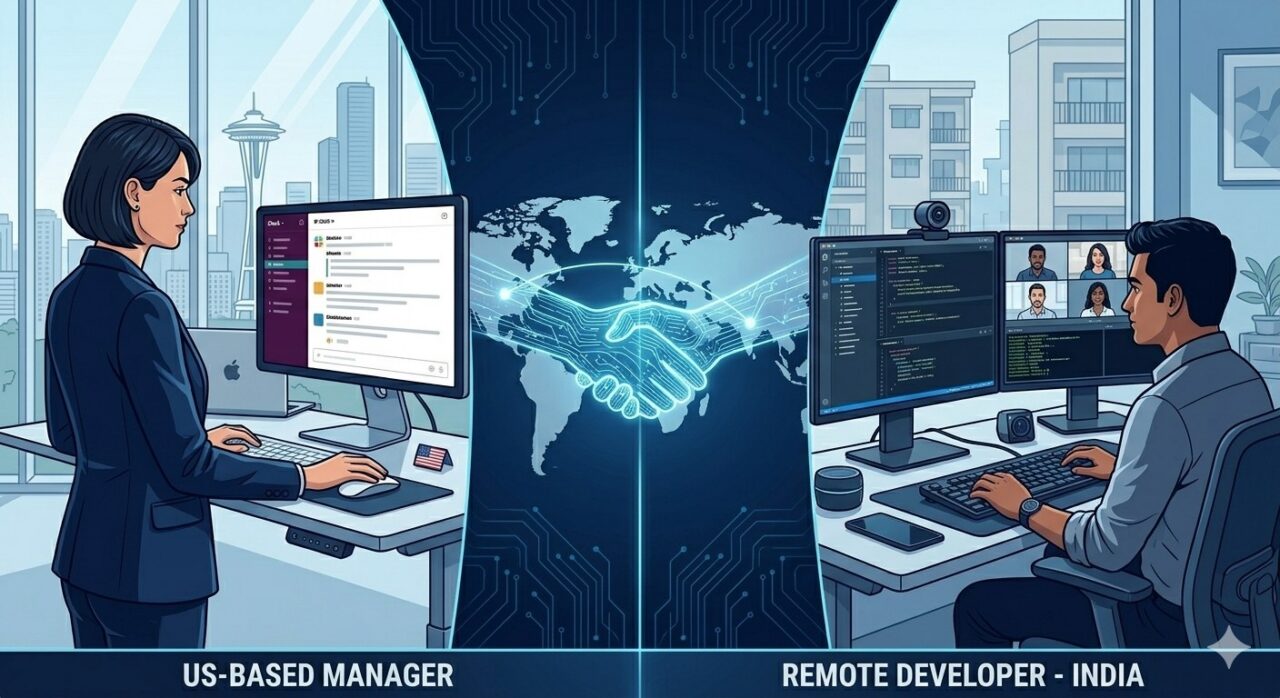
You have a product to build, a deadline that doesn’t move, and a hiring budget that isn’t what it was two years ago. You’ve posted locally. You’ve tried the big job boards. And you’re still three engineers short.
This is the situation pushing thousands of US businesses to hire remote employees in 2026 — not as a compromise, but as a deliberate strategy. Remote hiring has matured. The tools are better. The talent pool is deeper. And the companies doing it well are running circles around those still waiting for local candidates to apply.
But remote hiring done badly is expensive. Poor vetting, no onboarding structure, wrong timezone assumptions, and misaligned communication norms — these are real failure points that cost real money. This guide gives you the complete picture so you can build a remote team that actually performs.
Why the Decision to Hire Remote Workers Has Shifted in 2026
Remote work is no longer a temporary experiment or a pandemic-era concession. It has become the structural default for a growing segment of the global workforce — and for hiring managers, the implications are significant.
The Talent Geography Has Completely Changed
Limiting your search to candidates within commuting distance of your office means you’re fishing in a pond when there’s an ocean available. The top 10% of developers, designers, and operators in many disciplines are distributed globally — and a growing percentage of them are actively seeking remote roles with US companies.
US Labor Costs Haven’t Come Down
Despite the 2023–2024 tech layoff cycle, mid-to-senior talent in the US remains expensive. A full-time remote software developer in the US still commands $130,000–$165,000 in base salary. A remote hire from India or Eastern Europe with equivalent skills and English proficiency costs a fraction of that — with no sacrifice on output quality when vetted properly.
AI Has Made Remote Collaboration Dramatically Easier
Tools like Loom, Notion, Linear, and AI meeting assistants have collapsed the collaboration gap between co-located and remote teams. Async-first workflows are now mainstream, and managers who used to insist on in-person presence are finding that well-structured remote teams outperform their old office setups on delivery metrics.
Key Numbers to Know
| Metric | 2026 Reality |
| Remote workforce share (US) | ~28% of all professional roles are fully remote |
| Global remote talent pool | 200M+ skilled professionals actively seeking remote work |
| Avg. cost saving vs local hire | 45–70% depending on role and region |
| Time to hire (offshore remote) | 7–14 days via specialist staffing partner |
| Productivity parity | 80%+ of remote teams match or exceed in-office output |
How to Hire Remote Employees: A Step-by-Step Framework
There is a right way to hire remote workers — and it is more structured than most companies realize. Here is the framework our clients use to go from requirement to productive team member in under three weeks.
Step 1: Define the Role With Remote in Mind
A job description written for a local hire does not work for remote hiring. Remote roles need additional clarity:
- Timezone requirement: specify overlap hours, not just ‘flexible’. US EST 9am–1pm overlap is different from ‘fully async’.
- Communication expectations: daily standups, async updates, response time SLAs.
- Tools stack: list every tool the person will need to use from day one.
- Output definition: what does ‘done’ look like in the first 30, 60, 90 days?
Ambiguity in a local role is annoying. Ambiguity in a remote role is a delivery failure waiting to happen.
Step 2: Choose Your Hiring Channel Strategically
Not all remote hiring channels are equal. Here is an honest breakdown:
| Channel | Best For | Watch Out For |
| LinkedIn Remote Jobs | Senior roles, warm network hires | High noise, long cycle, expensive |
| Freelance Platforms (Upwork) | Short-term, project-based work | Inconsistent quality, high churn |
| Remote Job Boards (We Work Remotely, Remote.co) | Mid-level roles, inbound talent | Passive applicants, slow response |
| Offshore Staffing Partner | Pre-vetted, long-term remote hires | Quality varies by partner — vet the partner first |
| Employee Referrals | Culture-fit hires at any level | Limited reach, hard to scale |
Step 3: Screen for Remote Readiness, Not Just Skills
This is where most companies skip a critical step. A technically strong candidate who has never worked remotely will struggle in a distributed team. Your screening process needs to validate:
- Async communication quality: ask them to send a Loom video walkthrough of a past project. How they present matters as much as what they present.
- Self-management evidence: ask specifically how they prioritize when no one is watching. Vague answers are a red flag.
- Documentation habit: do they write things down, or do they operate entirely verbally? Remote teams run on documentation.
- Connectivity and workspace: for offshore remote hires, confirm a stable internet setup, backup power, and a dedicated workspace.
Step 4: Onboard Like You Mean It
Remote onboarding failure is silent. Unlike an office where you can see someone struggling, a remote hire who is confused or disengaged just goes quiet — and then leaves. A proper remote onboarding process includes:
- Day 1 welcome call with the full team — not just their direct manager
- Written onboarding doc: codebase/product context, tools access, communication norms, escalation paths
- Assigned buddy or mentor for the first 2 weeks
- Daily 15-minute check-ins for first two weeks — not to micromanage, but to unblock fast
- First deliverable within week 1 — small, achievable, and reviewed with real feedback
Tools That Make Remote Teams Actually Work
The difference between a remote team that ships and one that spirals is usually the tooling infrastructure. Here is what works in 2026:
| Category | Recommended Tool | Why It Works for Remote Teams |
| Communication | Slack + structured channels | Reduces email chaos, creates searchable async history |
| Project Tracking | Linear or Jira | Keeps distributed teams aligned on priorities and blockers |
| Documentation | Notion | Single source of truth — onboarding, processes, decisions |
| Async Video | Loom | Replaces 80% of meetings with clearer, reviewable walkthroughs |
| Code Collaboration | GitHub + Copilot | AI-assisted development + PR review workflow baked in |
| Meetings | Zoom + Otter.ai | Auto-transcription ensures remote participants don’t miss context |
| Time / Attendance | Hubstaff or Deel | Transparent tracking without micromanagement for offshore hires |
Common Mistakes When You Hire Remote Workers
Even experienced hiring managers get these wrong:
- Hiring for skills, skipping remote readiness. The best developer in a co-located environment can be the worst remote hire if they cannot communicate asynchronously or self-manage. Always screen for remote working habits explicitly.
- No written onboarding process. Verbal instructions don’t survive timezone gaps. If it isn’t written down, it doesn’t exist for a remote hire.
- Assuming timezone overlap will sort itself out. It won’t. Define the overlap window in the job brief. A developer in Bangalore and a PM in Chicago can make a 4-hour overlap work — but only if it’s agreed upfront, not assumed.
- Treating remote as a cost-cutting exercise only. Cutting cost is a valid reason to hire remote workers, but if it’s the only lens, you’ll under-invest in onboarding, tooling, and management — and end up with a team that underperforms.
- No clear performance framework. Remote employees without delivery metrics drift. Set 30/60/90 milestones, define output standards, and review them explicitly — not just in annual reviews.
Best Practices for Building a Remote Team That Performs
These are the habits of companies that consistently get the best outcomes from remote hiring:
- Document everything from day one. Your onboarding doc, team norms, and product context should exist in writing before your first remote hire starts — not assembled reactively as questions come in.
- Build culture intentionally. Remote teams don’t develop culture organically the way offices do. Schedule monthly all-hands, celebrate wins publicly in Slack, and invest in occasional in-person meetups if the team is long-term.
- Give autonomy within structure. Micromanagement kills remote team morale faster than anything. Define the outcome clearly, set the deadline, and then get out of the way. Check in on blockers, not on hours worked.
- Use a staffing partner for offshore remote hires. The vetting, compliance, and timezone management burden is significant for a first-time offshore remote hire. A specialist partner removes that friction and gives you pre-screened candidates in days, not weeks.
- Review performance by output, not activity. Deliverables completed, code quality, project milestones hit — these are real performance signals. Hours logged or message frequency are noise.
How QlickSource Helps You Hire Remote Employees Without the Headaches
Most remote hiring pain comes from one of three things: poor vetting, slow process, or no ongoing support after placement. QlickSource is built to solve all three.
Here’s what working with us looks like in practice:
- Pre-vetted talent pool: Every candidate has been screened for technical skills, English communication, remote working experience, and timezone compatibility with US business hours.
- 7–14 day placement: We deliver a shortlist of matched candidates in 5–7 business days. No months-long search cycles.
- AI-augmented profiles: Our developers and specialists are proficient in modern AI tooling, not just traditional skills — so they integrate into current workflows from day one.
- Compliance and contracts handled: We manage the employer-of-record complexity for offshore remote hires — payroll, compliance, and contracts — so you don’t have to.
- Ongoing performance support: We don’t disappear after signing. We stay involved through 30/60/90 day check-ins and are on call if performance issues arise.
Ready to hire remote employees who actually deliver? Book a free consultation with QlickSource and get a matched shortlist for your role in 5–7 business days. → www.qlicksource.com/contact
Final Thoughts
Remote hiring in 2026 rewards the businesses that treat it as a system, not a shortcut. The tools are there. The talent is there. The cost advantage is real. What separates remote teams that perform from those that fall apart is the quality of the process — how you define the role, how you vet candidates, how you onboard, and how you manage for output.
Whether you are hiring your first remote employee or scaling a distributed team of twenty, the framework in this guide gives you a foundation that works. Apply it consistently, invest in the right tools and the right partner, and remote hiring becomes a competitive advantage — not a risk.
Frequently Asked Questions
What is the best way to hire remote employees in 2026?
Start with a clearly defined remote-specific job brief that includes timezone requirements, async communication expectations, and 30/60/90 day output milestones. Use a vetted offshore staffing partner for speed and quality, or specialist remote job boards for inbound talent. Always screen explicitly for remote working habits — not just technical skills — and build a structured onboarding process before the person starts.
How do I hire remote workers from other countries?
You have three main options: hire directly as a contractor (simplest but creates compliance risk), use an employer-of-record (EOR) service like Deel or Remote.com to manage payroll and compliance, or use an offshore staffing partner like QlickSource that handles the employment relationship on your behalf. For most US businesses hiring from India or Eastern Europe, a staffing partner is the most efficient option.
How much does it cost to hire remote employees offshore?
A mid-level software developer hired offshore through a quality staffing partner typically costs $28,000–$45,000 annually all-in — compared to $160,000–$200,000 total employment cost for a US-based hire. For non-technical roles like digital marketing, content, or customer support, offshore remote hiring can cost as little as $12,000–$20,000 per year for experienced professionals.
How do I manage remote workers across time zones?
Define a minimum daily overlap window upfront — typically 4 hours is sufficient for most product and development workflows. Use async-first tools (Loom for video, Notion for documentation, Linear for task tracking) to reduce the dependency on real-time meetings. Set clear response time expectations, run structured daily standups in the overlap window, and evaluate performance on output — not availability.
What skills should I look for when hiring remote workers?
Beyond the technical or functional skills required for the role, prioritize: strong written English communication, demonstrated async work experience, self-management and time discipline, documentation habits, and familiarity with remote collaboration tools (Slack, Notion, Zoom, Jira or Linear). These ‘remote readiness’ skills predict success in distributed teams as reliably as technical competency.
Is it safe to hire remote employees from India?
Yes — with the right partner and process. India produces over 1.5 million engineering graduates annually and has a large, mature pool of professionals who have worked with US product companies for years. The risks (IP protection, accountability gaps, quality inconsistency) are process risks, not geography risks. A specialist staffing partner with proper vetting, NDAs, and ongoing accountability structures mitigates them effectively.
How quickly can I hire a remote employee through QlickSource?
Most clients receive a shortlist of pre-vetted candidates within 5–7 business days. Interviews are typically completed within 10–12 business days, and the selected hire can be onboarding within 2–3 weeks of first contact. This compares to an average of 8–14 weeks for a US-based remote hire going through a traditional job post and interview cycle.